
SIRCCOM
The Sirccom project addresses reliability and communication challenges in complex environments by deploying autonomous swarms of UAVs and UGVs for emergency response, data harvesting, and surveillance tasks. Individual research contributions from Laercio Lucchesi, Thiago Lamenza, and Millena Cavalcanti further advance this domain through developments in bearing-only target geolocation, deep learning communication constraints, asynchronous federated learning aggregation, and real-time distributed data fusion for search and rescue operations. You can view the full publication list at http://www.inf.puc-rio.br/~endler/publ.html.
GrADyS
There exist several situations where a geographic region of some size needs to be scanned or monitored through many sensors, but where it is either absolutely impossible or prohibitively expensive to deploy and maintain wireless communication infrastructure for the distributed sensors. Either because the region is hidden behind walls, not easily accessible, hard to get through, or because it is infected with some lethal bacteria or virus transmitter.
InterSCity
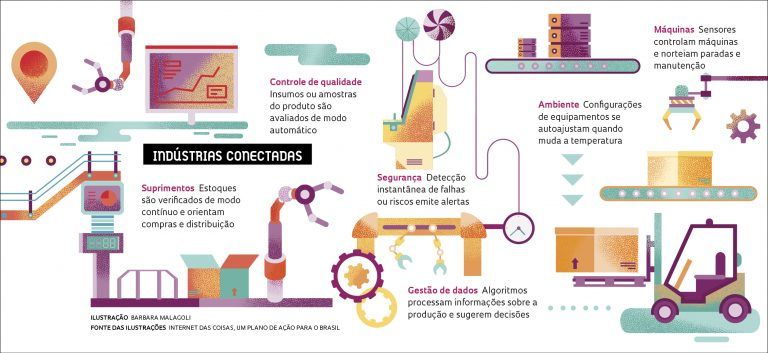
The Future Internet will integrate large-scale systems constructed from the composition of thousands of distributed services, while interacting directly with the physical world via sensors and actuators, which compose the Internet of Things. This Future Internet will enable the realization of the Smart Cities vision, in which the urban infrastructure will be used to its fullest extent to offer a better quality of life for its citizens. Key to the efficient and effective realization of Smart Cities is the scienti?c and technological research covering the multiple layers that make up the Internet. This paper discusses the research challenges and initiatives related to Future Internet and Smart Cities in the scope of the InterSCity project. The challenges and initiatives are organized in three fronts: (1) Networking and High-Performance Distributed Computing; (2) Software Engineering for the Future Internet; and (3) Analysis and Mathematical Modeling for the Future Internet and Smart Cities. InterSCity aims at developing an integrated open-source platform containing all the major building blocks for the development of robust, integrated, sophisticated applications for the smart cities of the future. Index Terms—Smart Cities, Internet of Things, Future Internet, Big Data, Machine Learning, Mathematical Modeling.
ESMOCYP
As distributed IoT applications become larger and more complex, the pure processing of raw sensor and actuation data streams becomes impractical. Instead, data streams must be fused into tangible facts and these pieces of information must be combined with background knowledge to infer new pieces of knowledge. And since many IoT applications require almost real-time reactivity to the stimulus of the environment such information inference process has to be performed in a continuous, on-line manner. This paper proposes a new semantic model for data stream processing and real-time reasoning based on the concepts of Semantic Stream and Fact Stream”, as natural extensions of Complex Event Processing(CEP) and RDF (graph-based knowledge model). The main advantages of our approach are that: (a) it considers time as a key relation between pieces of information, (b) the processing of streams can be implemented using CEP and that (c) it is general enough to be applied to any Data Stream Management System (DSMS).
H 4.0
The Internet of Things (IoT) has numerous applications in health care, from remote patient monitoring, smart sensors, integration of smart medical devices, to improving and optimizing the health care process. Some predictions say that in the next few years there will be a boost of IoT adoption in health care, both on the clinical side and the operational side. Specifically for the complex management of hospital operations, IoT will be able to solve well-known problems such as inefficient coordination of health care teams, poor allocation of space, human and material resources, and bad investment decisions. In this line we believe that an up-to-date knowledge of the whereabouts of patients, health care workers, and hospital equipment at all times will transform the way modern hospitals operate and are managed, leading to more efficient and effective businesses based on statistical analysis and real-time alert mechanisms. In this sense, we are developing Hospital 4.0, a distributed IoT application that delivers real-time statistical information to hospital administrators and the health care teams. Our solution works by capturing signals sent by bluetooth beacons worn by every patient and health professional (wristbands and ID tags. We use them primarily for identifying the localization, the timestamp of events and the co-located people. These gathered data are used to generate statistics about resource usage and notifications about emergency situations, which are displayed on managerial dashboards.